
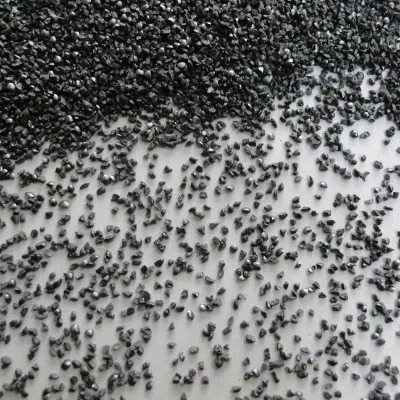
Steel Grit

High Carbon Steel Shot & Grit

Sand removal from large castings, scale removal from large products after forging, stamping, die forging, drawing and rolling processes or after heat treatment (e.g. pipes, profiles, plates, fittings and wire).

Sand removal from large and medium-sized castings, scale removal from forged and heat-treated workpieces, surface blast cleaning of steel plates, profiles and steel structures, shot peening of workpieces, granite cutting.

Sand removal from small and medium-sized castings, surface blast cleaning of forgings, heat-treated parts, steel pipes, profiles and steel structures, surface preparation before painting, shot peening of workpieces.

Surface blast cleaning of small-sized castings, forgings and heat-treated parts, aluminium and copper alloy castings, steel plates, steel pipes, profiles and steel structures, shot peening of workpieces.

Surface blast cleaning of stainless steel plates, thin steel sheets, non-ferrous alloys and dacromet-coated surfaces.”


More than 10 years of experience

Pasha Blasting offices in 2 countries


Grain sizes

Product Size range
Steel grit GH12 / GL12 / GP12 1,70 – 2,40 mm
Steel grit GH14 / GL14 / GP14 1,40 – 2,00 mm
Steel grit GH16 / GL16 / GP16 1,00 – 1,70 mm
Steel grit GH18 / GL18 / GP18 0,70 – 1,40 mm
Steel grit GH25 /  GL25 / GP25 0,40 – 1,20 mm
Steel grit GH40 / GL40 / GP40 0,30 – 1,00 mm
Steel grit GH50 / GL50 / GP50 0,20 – 0,70 mm
Steel grit GH80 / GL80 / GP80 0,10 – 0,40 mm
Steel grit GH120 / GL120 / GP120 0,10 – 0,30 mm

Specifications

Chemical composition (C): 0.80 – 1.20% (Mn): 0.60 – 1.20% (Si): ≥ 0.40 (S): ≤ 0.05% (P): ≤ 0.05%
Hardness GP: 42 – 52HRC, GL: 53 – 60HRC, GH: 60 – 64HRC
Hardness deviation Max. deviation ±3.0 HRC
Microstructure Tempered martensite or sorbite
Density 7.6 g/cm³
Bulk density 4.2 g/cm³

Application

Steel Grit Application
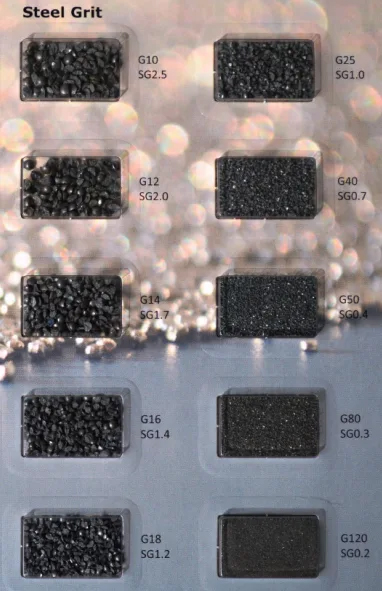
G10/SG2.5 G12/SG2.0 Sand removal of large sized castings, scale removal of large sized products from forging, stamping, dieforging, drawing and rolling or after heat treatment (e.g. pipes, sections, plates, fittings, wire).
G16/SG1.4 G14/SG1.7 Sand removal of large and medium sized castings, scale removal of forging and heat-treated work pieces, surface blast cleaning of steel plates, sections and steel structures, shot peening of work pieces, cutting of granite.
G18/SG1.2 G25/SG1.0 Sand removal of medium and small sized castings, surface blast cleaning of forgings, heat-treated pieces, steel pipes, sections and steel structures, surface treatment before painting, shot peening of work pieces.
G25/SG1.0 G40/SG0.7 Surface blast cleaning of small sized castings, forgings and heat-treated pieces, aluminium and copper alloy castings, steel plates, steel pipes, sections and steel structures, shot peening of work pieces.
G50/SG0.4 G80/SG0.3 G120/SG0.2 Surface blast cleaning of stainless steel plates, thin steel plates, non ferrous alloys, dacromet coat.

Steel grit Applications

Our steel grit abrasives are cost efficient due to the duribility and because recycling is possible. Due to long extremely long life time, savings are made on abrasive cost itself, but also on disposal costs.

Blast rooms

In blast rooms mainly our steel grit GH is used. This is the hardest and most aggressive abrasive available (60-64 HRC). Because compressed air and personal are expensive, it is favorable to use this product, because it has the quickest cleaning action.

In blast rooms this is used to remove old coatings, rust and mill scale. It is ideal for surface preparion and creating and anchor profile prior to coating, metalisation or powder coating. Our GH25, GH40, GH50 and GH80 are very often used in blast rooms. In case a very deep anchor profile is required of Rz > 120 um, the GH18 and GH16 can be considered.

Wheel Blast Machines

In shot blasting machines, mainly the softest steel grit GP is used (42-52 HRC). Steel grit GP is also referred to as angular shot, because it starts off angular but becomes round after some cycles in the wheel blast machine. When a more angular surface profile is required, steel grit GL (53-60 HRC) can also be used, for example when metallization follows after the blasting process. Not every wheel blast machine is suitable to work with the more aggressive GL hardness. This type of abrasive may never be used in wheel blast machines, because it will be brutal on the wear parts and inside of the machine.

In wheel blast machines steel grit is used for the removal of mill scale, rust, old coating layers on steel plates, steel beams and small steel parts. Steel grit is also used for deburring of metal parts and in the foundry industry the steel grit GP can be used for desanding of the foundry parts. Larger parts require a larger size abrasive.

Sometimes steel grit GP is added to work mix of shot to get some extra profile and aggressiveness to the blasting process.

Blast Cabinets

In pressure blast cabinets steel grit of GH hardness can be used, normally a finer grain size. Vacuum injection blast cabinets are not suitable, because the specific weight of this abrasive is too high for this blasting method.

Vacuum Blasting Machines

In strong vacuum blasting machines like the AB1070, this product can be used. Normally, the grain size GH40 or GH25 is suitable for this application.